Latest result
· Brouwer’s table of constant-weight codes
A(27,6,11) ≥ 19 344
Previously 19 305: 39 words added to the table’s code, none removed.
Each result is published with its certificate, which anyone can download and check.
Non-profit association under French law, declaration in progress. Clermont-Ferrand.
· Brouwer’s table of constant-weight codes
Previously 19 305: 39 words added to the table’s code, none removed.
The table’s credit line now reads “Antoine Olivier, emails 2026-10-10, 2026-10-19, with 2+10 new codes”: two codes sent on 10 October and ten on 19 October. Each code was checked by three independent verifiers and timestamped.
They are listed as computational records, credited to an anonymous user until the table’s maintainer reviews them.
a27.6.11.19344HBinary words of length 27 and weight 11, any two at distance 6 or more.Synthetic example; script not yet published
$ python verify.py a27.6.11.19344H 27 6 11
19344 words, weight 11, min distance 6: OK
Ten cells of Brouwer’s table of constant-weight codes carry the mark Ol; an eleventh, A(29,8,8), has since been raised from 1 062 to 1 064 by another contributor. Ten spherical codes with a lower maximal cosine than the entries of Cohn’s table were sent on 19 October 2026; they are listed there as computational records, credited to an anonymous user until the table’s maintainer reviews them.
Contributions: verifier replays for the κ bounds of integer multiplication, credited by the maintainer of that campaign; an independent re-check of a third-party catalogue of TESS planet candidates, which led to corrections.
Campaigns are open to outside contributors and credit every contributor. The working group talks in a private Matrix room.
Write to research@keplercircle.org. Membership is free for the first financial year.
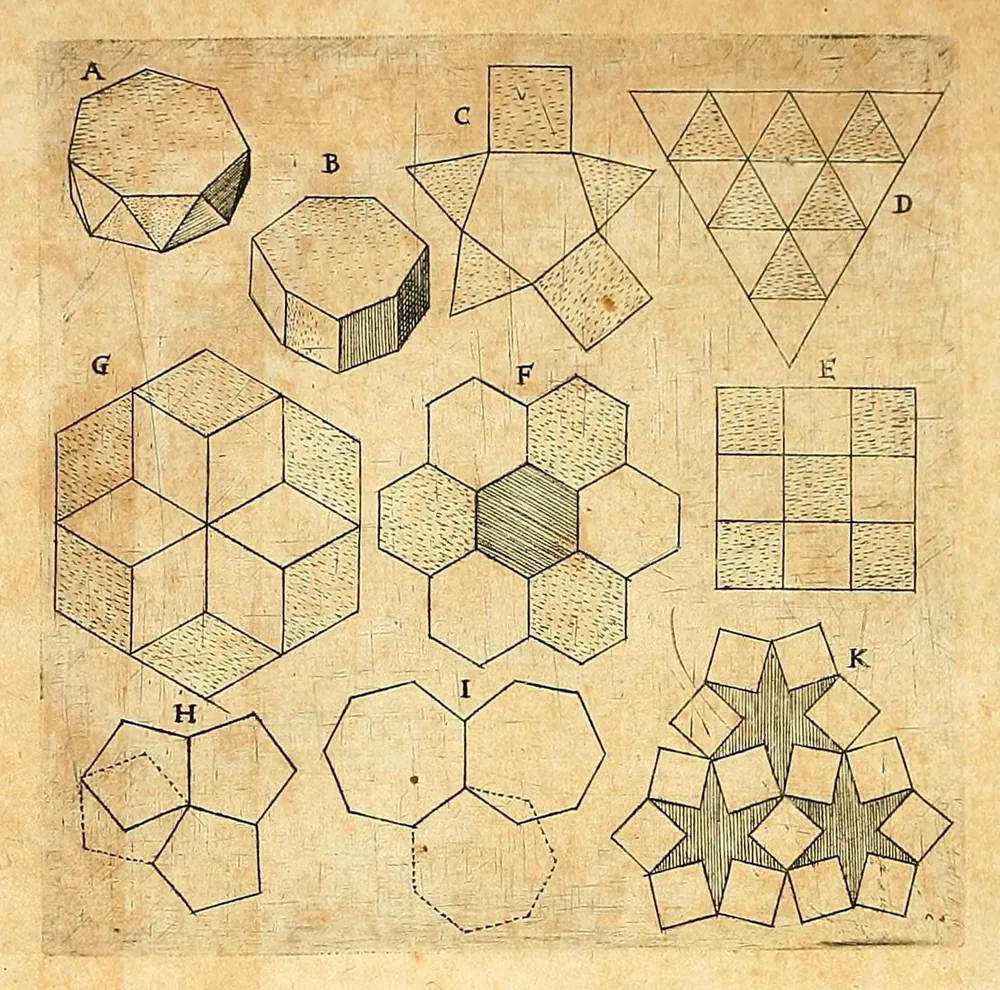
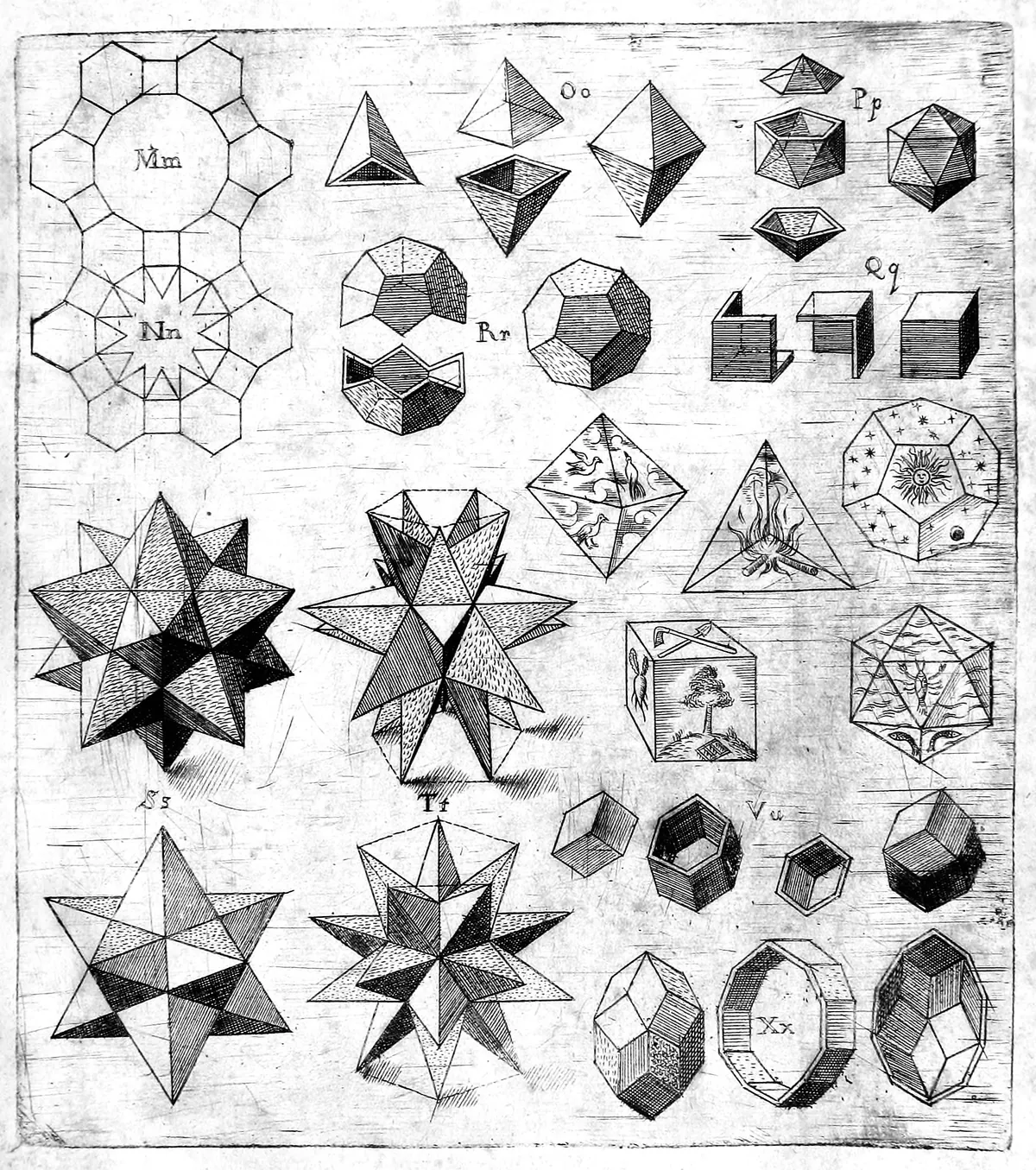
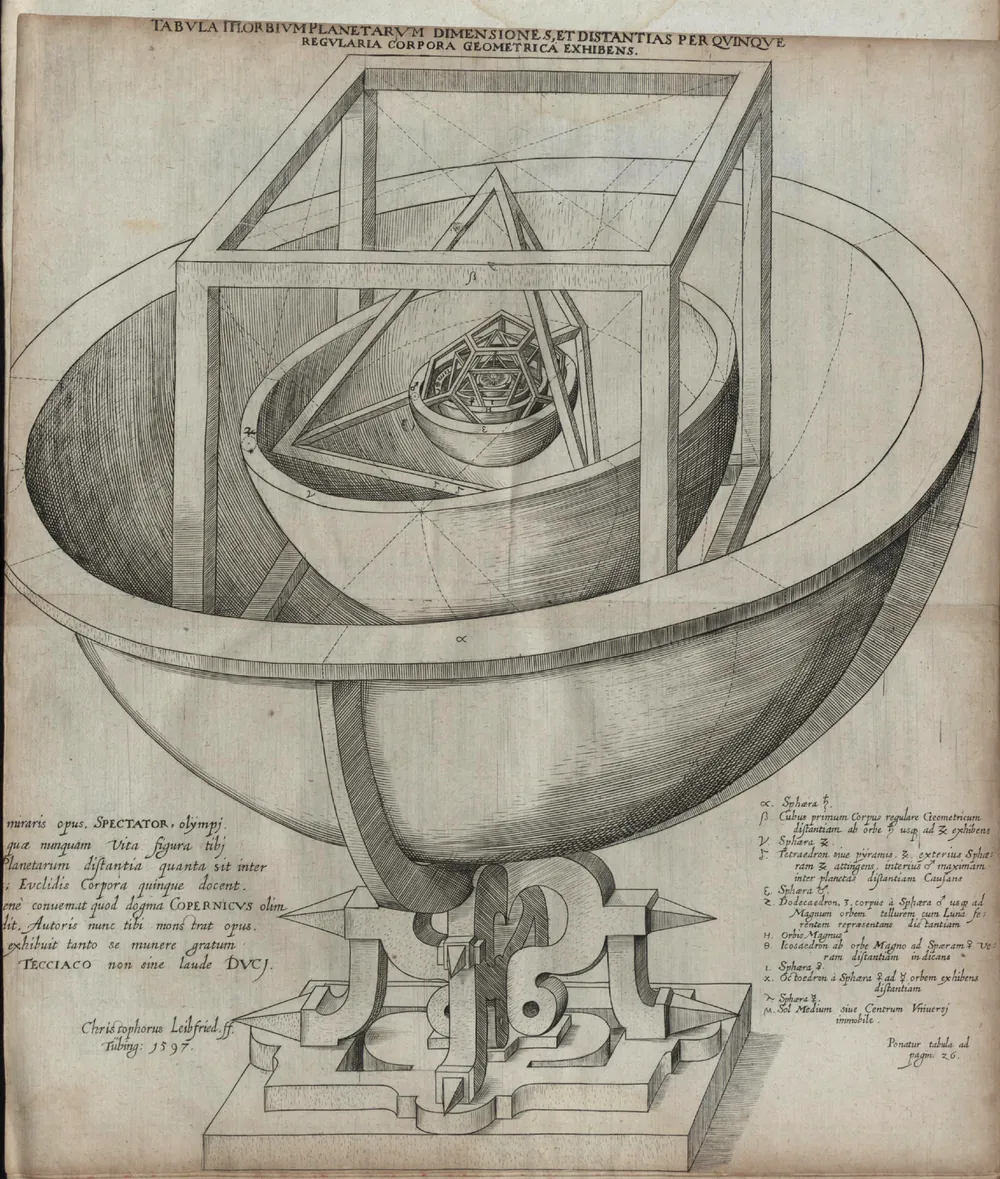
Regular and star polyhedra from Harmonices mundi, 1619. Smithsonian Libraries, public domain.
Every result comes with its certificate, the code itself, which anyone can download and check.
The method is public (the roles of the models, the verification gates); prompts and orchestration stay private.
Constant-weight codes, three independent verifiers and a timestamp; spherical codes, integer coordinates (×252), two exact engines (Python and PARI/GP), a hostile review and a timestamp of the 71 files.
A circle can be pictured as a polygon whose sides keep multiplying without end. In our case, each side stands for a person and an AI doing research together. The more sides there are, the closer the shape comes to a circle.
The picture comes from Kepler himself. In Nova stereometria (1615), he found the area of a circle by cutting it into infinitely many tiny triangles, each resting on one side and pointing to the centre.
Kepler also showed what two talents can do together. Tycho Brahe recorded the positions of the planets for almost twenty years; Kepler looked for the law in those measurements, and elliptical orbits came out of it.
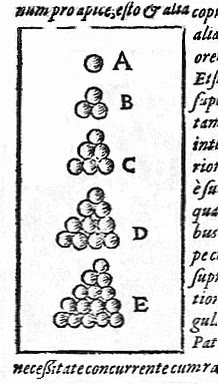
Finally, in 1611, Kepler claimed that no packing of spheres is denser than the greengrocer’s stack of oranges. The proof came in 1998, with the help of a computer (Thomas Hales and Samuel Ferguson), and a proof assistant checked every step of it in 2014 (the Flyspeck project). That is the kind of research Kepler Circle sets out to do.
Kepler Circle is a French non-profit association (loi 1901, declaration in progress) for scientific research in every field: mathematics, computer science, physics, astronomy, biology, chemistry and climate science. It publishes its results in open access, with certificates anyone can download and check.
President and spokesperson: Antoine Olivier · research@keplercircle.org